Murfreesboro Oral Surgery & Implant Center

Calming Your Nerves Before Dental Procedures

Almost everyone has some feelings of nervousness when thinking about visiting the dentist.  We hear it all the time from our patients.  But don’t worry (I know, easier said than done).  It is totally normal to have a bit of anxiety (or even a lot of anxiety) before you come to our office.

CalmingIn our office, we have many years of experience in dealing with nervous patients.  So to help you out, we’ve compiled this quick yet effective set of tips for dealing with those inevitable nerves before your dental procedure.

  1. Let us know!  Sometimes just saying the words, “I’m a little bit nervous” can help by normalizing the nervousness itself a little bit, which instantly releases some of that stress that has the tendency to build up in your system. It also alerts us, which is great!  In fact, we might just be able to help by doing procedures a little bit differently than we normally would or even just by offering some words of encouragement and reassurance.
  2. Music – Ask us to turn up (or down) the music in your exam room if that helps.  Or, depending on the procedure, you may even be able to listen to your own MP3 player while we work away.  Ask us ahead of time to be sure the procedure will allow for this.
  3. Breathe – Did you know that consciously taking a breath instantly calls to action your parasympathetic nervous system which is the part of the brain responsible for calming you down?  The good news is that you always have your breath with you, so don’t forget to use it!  Just by paying attention to your breath, for example, how it feels coming in and going out and the other sensations it creates, you can access the calming center of your brain.  An easy breathing exercise that can be used anytime, anywhere, including in the dental chair is to breathe in for 4 counts, then out for 4 counts.   You will instantly feel better.

We hope you find these tips helpful in dealing with your dental fears.  Just remember, you are not alone.

Wisdom Teeth: What’s the Big Deal?

Especially with the younger crowd, this is a question we get time and time again in our office!  And understandably so!  To some, removing the wisdom teeth seems like it should be an elective procedure, not a necessary one.

Wisdom teeth whats theYou have probably heard the statistic that 85% of people have to have their wisdom teeth (also called “third molars”) extracted at some point during their life.  But you may be wondering “Why?”  (As in “Why fix it if it isn’t broken?”)

Well, as it turns out, naming these teeth “wise” demonstrates a very questionable use of vocabulary.  “Wisdom” teeth actually turn out to be more like “trouble makers” for most people, and the common removal of them during the young adult years is done as a necessary preventative measure to avoid much bigger problems down the road.

What kind of problems are we preventing? 

One of the problems wisdom teeth present is that often there is no place for them to grow.  The average mouth is designed to accommodate 28 permanent teeth, not 32.  What ends up happening is that the third molars start to grow horizontally, inward or outward or even into the jaw bone, eventually crowding the nerves and causing pain.

In the case of impacted teeth, they may be “stuck” in the jawbone, only able to partially erupt through the gums.  This can create an inlet for bacteria with the potential to cause serious infection inside the mouth and jaw area.  Furthermore, brushing and flossing becomes a problem, which leads to more problems with decay and infection.

Still not convinced as to why we would perform the procedure now instead of just waiting to see if you develop problems later in life?   Great question!  As it turns out, we have a very good reason for that as well:  In a teen or young adult, the removal of wisdom teeth is much easier to perform with less pain and complications simply because the roots have not fully formed yet.  Once those roots set in the surgery becomes more complicated.

We understand your hesitations about wisdom teeth removal, and we’d be happy to answer any other questions you have about your wisdom teeth, give us a call today!

Can My Dental Implants Get Cavities? And other common questions…

In my practice, I hear dozens of questions every day about dental implants from concerned (or simply curious) patients.  Every one of those questions is a good question and I always try to provide an equally good answer.  To help you better understand an upcoming dental implant procedure, we’ve compiled a top-five list of the most common questions about dental implants that we field in our office every day:

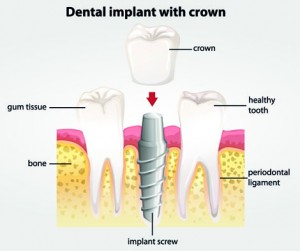
Can my dental implants1.  Can dental implants get cavities? 

No.  Because the implant-restored crown is an artificial (not natural) material, it cannot grow cavities, phew!  However, you still need to have regular gum care and cleanings around the implant site just like you would for a natural tooth.

2.  Can implants slip or fall out like dentures?

No.  The artificial tooth (crown) is attached to the permanent titanium post that is set in the jaw.  They will not slip around or fall out like you may have experienced with dentures.

3.  Can I sleep with my dental implants in?

Yes!  They are practically “permanent”, unlike dentures.  You do not need to remove and soak them overnight.

4.  Aren’t dental implants more expensive than bridges and dentures? 

It depends.  If you are talking about just a few teeth, implants may be cheaper over time than bridges because they last longer.  However, if you need a whole row of teeth replaced, dentures may be a less expensive option for you.  Each case is unique, however, so be sure to call us for a proper consultation.   We are here to help you understand your costs and benefits so that you can make an informed decision.

5.  How long will my dental implants last?

If implanted and cared for properly, dental implants can last for many decades or possibly even a lifetime.  Some implants have been in patients for over forty years!

Don’t see your question on our list?  Contact us today for quick answers! 

Will Wisdom Teeth Someday Become Obsolete?

Most people are familiar with third molars, more commonly known as “wisdom teeth”.  It is usually suggested that a young adult entering the “age of wisdom” have any existing wisdom teeth removed prior to developing any problems. Because most people’s mouth do not have room for these third sets of molars, the remaining wisdom teeth often fail to erupt and can cause pain, infection or Will-Wisdom-Teeth-Someday-Become-Obsolete copyinflammation.

However, you might not realize that about 35 percent of the population doesn’t experience any third molar development. This percentage is slowly growing, begging the question of whether we are on an evolutionary track of losing them completely.

Scientists still aren’t sure of the role that DNA plays in third molar development. One large difference in third molars is that they are the only teeth to develop entirely after birth, which makes it harder for nature to select against them. There may also be environmental factors at work. Studies show that certain cultures have fewer incidences of third molars, but scientific evidence of influencing factors is still to be determined.

As science progresses, many believe bioengineering could be used to prevent the development of third molars altogether. For wisdom teeth to form, a special tissue that promotes the bone growth has to migrate back into the mouth to interact with jaw tissue. Some scientists have begun work on administering a laser or chemical agent that would prevent this process.

It is hard to say what the future might hold for wisdom teeth. For now, we continue to recommend removing your wisdom teeth to avoid the pain and periodontal disease that results from impaction of wisdom teeth. Moreover, this surgery should take place during the young adult years prior to the teeth attaching to the jaw and becoming more difficult to extract.

Wisdom tooth removal in our office is a relatively simple process. Call us to reserve a consultation today!

Tags: , ,

What To Expect When Having a Tooth Extracted

What-To-Expect-When-Having-a-Tooth-Extracted One of the most common procedures done in our office is tooth extraction. The removal of teeth can be necessary for a number of reasons, including:

  • Joint problems in your jaw
  • Shifting teeth
  • Too much damage to tooth to be repaired
  • Baby teeth that don’t fall out
  • 3rd molars (Wisdom Teeth) impacted (wedged between the jaw and another tooth or teeth)
  • May be needed to create room for other teeth (such as when you’re getting braces)

Prior to Surgery

In preparation for surgery, we will obtain a full medical and dental history, as well as a list of all medications you take. This includes any vitamins, supplements, or over-the-counter drugs, as well as any medications you are allergic to.

An x-ray is then taken to assess the best way to remove the affected tooth.

You may be required to take antibiotics before or after surgery, depending on the duration of the surgery, or if you have a specific medical condition. Drs, Hollis & Spivey  will discuss this with you if necessary.

Day of Surgery

At the time of surgery, your oral surgeon will numb the area around the tooth or teeth to be extracted with a local anesthetic, specifically numbing the affected tooth or teeth, your jawbone and the surrounding gums.

During the simple extraction process it is common to feel a lot of pressure. The affected tooth is firmly rocked back and forth so as to loosen it for removal. You should not feel any pain, just pressure. If, for any reason, you feel pain, please notify your oral surgeon immediately so that they can administer more numbing agent.

Surgical Extraction

A surgical extraction is a slightly more complex procedure that occurs when a tooth has not yet broken through the gum line, or has not yet fully grown into the mouth. When a surgical extraction is needed, your oral surgeon makes a small incision into your gum in order to access the affected tooth. From here, the procedure is similar to a simple extraction. Your oral surgeon may stitch the incision site if necessary.

After Oral Surgery

After the extraction you will be asked to bite down on a piece of gauze for 20-30 minutes. This pressure helps to form a blood clot in the extraction site, a crucial part of the healing process. Be careful not to dislodge the clot.

It is common to have a small amount of bleeding 24 hours after surgery. We will provide you with detailed instructions after your procedure, but here are some important things to remember:

Medications/Pain Management

  • Take pain medication as prescribed and recommended by your oral surgeon
  • Research has shown that taking anti-inflammatory drugs, such as Advil and Motrin (NSAIDs) greatly decrease pain after an extraction
  • Using an ice pack on your jaw can reduce swelling. 10 minutes on and 20 minutes off is standard for the first 24 hours. A warm compress can be used if your jaw is sore after the swelling has gone down

Eating/Drinking

  • Eat soft and cool foods for the first few days
  • Avoid hot foods and alcoholic beverages for the first 24 hours
  • Chew food away from the extraction site
  • Do not use a straw or spit after surgery. This can cause the blood cut to dislodge, greatly delaying healing

Brushing/Cleaning

  • Avoid brushing the area around the extraction site for the first 24 hours
  • Avoid using antiseptic and commercial mouth rinses – they can irritate the extraction site
  • 24 hours after surgery you can rinse with warm salt water after each meal and before bedtime (1/2 teaspoon in one cup of warm water)

Healing

The extraction site will generally close up in about 2 weeks time, but it can take three to six months for the bone and soft tissue to regrow. Remember, tooth extraction is a common procedure and our caring team has years of experience helping patients through this easy treatment.

Tags: , , , ,

The Evolution of Dental Care: From Finger to Floss

Did you know that the toothbrush is one of the oldest tools that humans still use? In fact, in a survey conducted in 2003, Americans chose the toothbrush as the number one invention over the car, personal computer, cell phone, and microwave. This may come as a shock in a day and age obsessed with technology, but it just goes to show how much value we place on our pearly whites. But it makes you wonder… how have people kept their teeth clean throughout the centuries? How did the toothbrush, toothpaste, and floss come into existence and how have they evolved over time?

One would assume that the first toothbrush was surely the finger, but evidence has shown that as far back at 3500 BC to 3000 BC chewing sticks were used in Babylonia. These chewing sticks were essentially a stick from an astringent tree with a frayed end that acted as bristles to clean teeth. These chewing sticks have also been found in ancient Egyptian tombs. Their predecessors are still commonly used in certain areas of the Middle East, Africa, Asia, and South America and are known as miswak or mswaki sticks.The Evolution of Dental Care

When excavating Ur in Mesopotamia, ornately decorated toothpicks were found that dated back to 3000 BC. Other archaeological digs have recovered various tree twigs, bird feathers, animal bones, and porcupine quills as the earliest toothbrushes and toothpicks. An ancient Sanskrit text on surgery dating back to the 6th century describes severe periodontal disease and stresses oral hygiene; “the stick for brushing the teeth should be either an astringent or pungent bitter. One of its ends should be chewed in the form of a brush. It should be used twice a day, taking care that the gums not be injured.” Pretty sound advice, even by current standards! Ancient Greek and Roman literature referenced the use of toothpicks to keep their mouths clean, and ancient Roman aristocrats kept special slaves for the sole purpose of cleaning their teeth. Imagine that job!

Ancient Chinese writings from around 1600 BC portray chewing sticks that were derived from aromatic trees and sharpened at one end to act as a toothpick. In the thirteenth century, the Chinese began to attach boar bristles to bamboo, essentially fashioning the first toothbrush. The optimal choice for bristles was taken from the back of the necks of cold climate boars, generally found in Siberia. Traders introduced these toothbrushes to the West and they quickly gained popularity. At that time Europeans were brushing their teeth by dipping a linen cloth or sponge in sulfur oils and salt solutions to rub away tooth grime. This was referred to as “The Greek Way”, as Aristotle had recommended this method to Alexander the Great. As these toothbrushes spread from East to West, in the West they preferred softer horse hairs over the coarse boar bristles, yet horses were deemed too valuable for the sake of toothbrushes, making boar bristles popular well into the early 1900’s.

Fast-forward to 1780 and we meet a man named William Addis of Clerkenwald, England. Addis was sitting in Newgate Prison for allegedly inciting a riot. The method for brushing teeth in jail was to take a rag and dip it in a solution of soot and salt and rub it onto the teeth. Addis believed there had to be a more efficient way, so while he passed his time in jail he began to think up solutions. Spying a broom, inspiration struck him and he took a small animal bone leftover from his meal and drilled holes into it. He then tied some swine fibers into bunches, strung them through the holes, and glued them into place. At this time in Georgian England, refined sugar was being shipped in from the West Indies in mass quantities. This caused a huge increase in the consumption of sugar for Londoners who then suffered from rotting teeth, the only treatment for which was to pull the infected teeth. When Addis was released from jail, he went on to market and sell his toothbrush under the name Wisdom Toothbrushes, which went on to become a very successful business that is still around today.

Toothbrushes continued to be made with animal bone handles and more often than not, boar bristles, although fancy toothbrushes were made with badger hair for those who could afford them. Celluloid handles were introduced in the 1900’s and quickly replaced bone handles. In the 1920’s a new method of attaching bristles to the handle was developed: holes were drilled into the brush head, bunches of bristles were then forced through the holes, and secured with a staple. This method is the same method that is commonly used today.

The next evolution in toothbrushes occurred when Wallace H. Carothers of Du Pont Laboratories invented nylon in 1937. Nylon bristles quickly overtook animal hair bristles for sanitation and cost-effective purposes. Although boar hair bristles often fall out, do not dry well, and are prone to bacterial growth, they strangely still account for 10% of the toothbrushes sold worldwide. The new nylon bristled toothbrushes were sold as “Doctor West’s Miracle-Tuft Toothbrush” due to its more hygienic properties.

With World War II looming in the background, British and American housewives were instructed to waste nothing, which translated to no more bone handles for toothbrushes. Bone handles had long been popular for things like toothbrushes, knives, guns, and handles for many more items. The shift to celluloid was a natural progression as soup bones were needed more than ornate bone handles. World War II gave oral hygiene an unexpected boost. The soldiers in World War II were expected to brush twice daily, a habit they brought home with them, likely due to the fact that Trench Mouth had become so rampant during World War I.

And what about toothpaste? Well, ancient Egyptians were making a “tooth powder” as far back as 5000 B.C.E. It was made from ox hooves, myrrh, eggshell fragments, and pumice. No device was found with the remnants of the tooth powder, which is why it is assumed that the finger was the first actual toothbrush. Other early tooth powders contained mixtures of powdered salt, pepper, mint leaves, and iris flowers. In Roman times, urine was used as a base for toothpaste. And since urine contains ammonia it was likely an effective whitening agent. In later times, homemade tooth powder was made of chalk, pulverized brick and salt. It is said that Napoleon Bonaparte regularly brushed his teeth with an opium-based toothpaste. In 1873, Colgate mass-produced the first toothpaste in a jar called Crème Dentifrice. By 1896, Colgate Dental Cream was packaged in collapsible tubes. Finally, by 1900, a paste of hydrogen peroxide and baking soda was developed, and by 1914 fluoride was introduced and added to the majority of toothpastes on the market at that time.

And what of floss? Researchers have found floss and toothpick grooves in the teeth of prehistoric humans. But it wasn’t until 1815 when a New Orleans dentist named Levi Spear Parmly promoted flossing with a piece of silk thread that floss really gained notoriety. Levi went on to be credited for inventing the first form of dental floss. By 1882 the Codman and Shurtleft Company of Randolph, Massachusetts began mass-producing unwaxed silk floss for commercial use. In 1898 Johnson & Johnson received the first patent for dental floss.  Dr. Charles C. Bass then developed nylon floss, which performed better than silk because of its elasticity. Today floss is still made of nylon.

Who would’ve thought that the history of dental care would be so fascinating? And who would’ve guessed that the toothbrush we use today evolved from a stick and was perfected by a convict? Today, there are over 3,000 patents worldwide for toothbrushes. Regardless of how they got here, toothbrushes, toothpaste, and floss are a necessity in our daily lives.


Tags: , , , ,

FAQs Regarding General Anesthesia for Oral Surgery

FAQ-Regarding-General-AnesthesiaHere in our office we perform a variety of treatments including dental implants, facial reconstruction and teeth removal. If you have recently been diagnosed with a condition that requires any of these types of treatment, you will likely be required to go under general anesthesia.
For some people, impeding anesthesia can induce a bit of anxiety. We completely understand what you are feeling and believe that proper education can help put your fears at ease. The following are some of the most common questions our patients have before “going under”.

What is exactly is general anesthesia?

General anesthesia is a medically induced loss of consciousness (or sleep) that affects your entire body. This administration of a variety of medications is extremely beneficial for both our patients and our oral surgeons. The side effects include:

The purposes of general anesthesia include:


  1. Analgesia (loss of pain)
  2. Amnesia (loss of memory)
  3. Immobility
  4. Unconsciousness
  5. Skeletal muscle relaxation.


Is anesthesia safe?

Due to many advances over the past 25 years, the risks of anesthesia are very low. Certain types of illnesses, such as heart disease, high blood pressure and obesity, can increase your anesthesia risks. Still, even very sick patients are routinely brought through major operations safely.

Adverse events are very rare. The specific risks of anesthesia vary with the particular procedure and the health of the patient. You should ask your oral surgeon about any risks that may be associated with your specific condition.

What should I know before I come in?

Before you go to have your procedure completed under general anesthesia, here are a few requirements:

l    Have a responsible adult accompany you to drive you home.

l    Do not eat or drink anything before 8 hours of surgery.

l    Do not drive or operate machinery for 24 hours after surgery.

l    Do not wear contact lenses, jewelry, or dentures during the time of your

procedure.

l    Do not wear excessive makeup, lipstick, or nail polish on day of surgery.

l    Make sure to notify your oral surgeon of any illness, cold, sore throat, or upset stomach.


Are there side effects I should be aware of?

There are a few different side effects of general anesthesia. The most common are nausea, sore throat, sleepiness, and shivering. However, effects may vary greatly with each patient — it all depends on how your body reacts to it. It’s a good idea to consider any prior experience(s) with general anesthesia to get an idea of what to expect during your next oral procedure.

Please do not hesitate to contact our office with any remaining questions you have. We are happy to answer them!


Tags: , , , , ,

Dentures – The End of An Era

Dentures---The-End-of-An-EraYou may have heard the term “edentulous”, a term that describes someone that has no teeth. Incredibly, more than 35 million Americans do not have any teeth. Despite advances in dentistry, this number is expected to grow in the next two decades along with an aging baby boomer generation. Tooth loss commonly results from decay and gum disease.

Up until now, the only option for edentulous patients has been dentures. Their history is a long one. Scientists have found evidence of early dentures, dating back to 700 BC in present-day northern Italy, made of human and animal teeth. Over the years, the materials changed, but the inconvenience of ill-fitting dentures did not.

While dentures are extremely common, most patients find them uncomfortable and awkward. They can make daily tasks most of us take for granted, like talking and eating, difficult.

Presently, dental implants are rapidly becoming the standard of care. The biggest difference in the patient’s experience is that dental implants look and function just like their natural teeth. Most dental implant patients even report not being able to feel a difference! They do not slip or move inside the mouth as dentures are prone to do. Dental implants will generally last longer, as well. This is an important point to consider when comparing costs. While implants are more expensive, they usually last a lifetime. Dentures, on the other hand, can wear down and require replacement.

For patients looking for a more affordable replacement option, with the increased stability of implants, they may want to consider implant-supported dentures. Unlike traditional dentures, which rely on suction, implant-supported dentures are secured by dental implants. Regardless of which route an edentulous patient takes, it is clear that benefits of implants far outweigh those of dentures and will pave the way for a new era in tooth replacement.

If you are interested in exploring dental implants as a replacement for your own dentures, give our office a call to reserve a consultation today!

Tags: , , , , , ,

Could Diamonds be an Oral Surgeon’s Best Friend?

Could Diamonds be a Periodontist's Best Friend Drs, Hollis & Spivey routinely replace missing teeth with dental implants here in our office.  Dental implants are artificial tooth “roots” made of titanium, used to anchor dental prostheses, including crowns, and implant supported bridges and dentures. One of the largest factors in successful dental implant placement is adequate, healthy bone density to anchor the post.

Unfortunately, not all patients have the proper bone in their jaw to support a dental implant. Some patients suffer from Osteonecrosis, a disease caused by reduced blood flow to bones. When there is not enough blood flow, bone can start to die and break down. This makes dental implants for these patients particularly susceptible to becoming loose or failing. Osteonecrosis can be a side effect of chemotherapy.

Scientists from the UCLA School of Dentistry have discovered that nanodiamonds could be used for stronger dental treatments. Nanodiamonds are much smaller than those traditionally used in jewelry.

Currently, standard bone repair operations include inserting a sponge surgically to administer proteins that promote bone growth.  This new study, led by Dr. Dean Ho, may have uncovered is an easier way to deliver these proteins. Nanodiamonds, which are invisible to the human eye, bind rapidly to the materials needed for bone growth. This process can be done through injection or an oral rinse, rather than surgery.

“This discovery serves as a foundation for the future of nanotechnology in dentistry, orthopedics and other domains in medicine,” said No-Hee Park, dean of the School of Dentistry. “Dr. Ho and his team have demonstrated the enormous potential of the nanodiamonds toward improving patient care. He is a pioneer in his field.”

Results from the study will most likely pave the way for more study. Either way, stay tuned to find out how diamonds are playing a role in oral health care.

Read the full article from UCLA’s newsroom here: http://newsroom.ucla.edu/portal/ucla/nanodiamond-encrusted-teeth-248066.aspx

Dental Implants vs Dentures and Bridges

Whether it was during a consultation in our office or perhaps while you were doing your own research online, you have probably come across the term “dental implant” at some point. A dental implant is a great way, often the best way, to replace a missing tooth.

So how do you decide if a dental implant is the right path for you, or if a more traditional tooth replacement method such as dentures or bridges is the best way to go?

We have been asked this question many times, and have compiled a comprehensive breakdown of the benefits that implants offer over their conventional counterparts. We hope that this guide will help make the decision process easier for you.

Dental Implants vs. Dentures and Bridges: Things to Consider

  • Longevity: Dental implants offer a long-term solution (often lasting a lifetime) to missing teeth, while dentures and bridges require replacement every 5 to 10 years. Not only does this mean less hassle, it also means that implants may be more affordable over time.
  • Quality of Life:
    • Simply put, dental implants look, feel and function more like natural teeth than do dentures and bridges.
    • With a dental implant, our patients can hardly notice the difference when biting into hard objects. They also look more natural.
    • In addition to that, dental implants are fixed – they are not going to fall out while you are talking or smiling, and you don’t have to put them away each night when you go to sleep. They remain in your mouth, anchored to your jawbone at all times.
  • Bone Stability and Health: Just like muscles, bones also need a “workout” in order to maintain their mass and health. So when a tooth is missing from the jawline, the bone underneath the old tooth site becomes atrophied and shrinks. Dentures and bridges do nothing to help this deterioration. However, dental implants actually screw into the bone and integrate with it, actually encouraging new bone growth.
  • Overall Health: Because implants allow for a normal range of food choices in the diet (a benefit not afforded by dentures), they encourage you to continue your healthy lifestyle for the rest of your life!

Do you still have questions? As always, we are here to answer any questions you have. Give us a call for more information!